2026 Complete Guide
What Is Generative BI?
How generative AI in business intelligence turns plain-English questions into answers, charts and dashboards, and what it takes to put it to work in your business.
On this page
Related guides
AI analytics
Dashboards
Reporting
Topics
Generative BI GenAI NLQ Self-service Dashboards Data storytelling LLMs
See GenBI on your data
A free 30-minute walkthrough on your own stack, with pricing covered openly.
- Analytify Team
- Updated September 2026
- Generative BI, AI Analytics
- 18 min read
Generative business intelligence (generative BI) represents the next evolution in data analytics, combining AI capabilities with traditional BI tools. This new approach is changing how organizations use their data. It makes advanced analytics easy for non-technical users. This works through natural language processing and automated insight generation. As businesses seek competitive advantages, generative BI offers a robust solution. It makes insights more accessible and speeds up the analytics process.
Generative BI is still new. Only 3% of organizations have used it. More than 50% are still in the experimentation phase. The market is set for significant growth, with an average ROI of 41% from generative AI efforts. This guide covers everything you need to know about generative business intelligence. It includes core concepts and strategies for implementation.
What is Generative BI?
Generative BI enables users to interact with data using natural language queries instead of complex SQL commands. It shows a big change in how organizations use data for decision-making. Business intelligence is changing. It is no longer for experts with special skills. Now, all business users can access it.
GenBI - GENAI / GenAIQ in Analytics
Integrated BI Platforms
Specialized GenBI tools
Open Source Frameworks

Traditional BI vs Gen BI
| Aspect | Traditional Business Intelligence | Generative BI |
|---|---|---|
| Query Method | SQL queries & technical expertise required | Natural language input |
| Content Creation | Manual dashboard creation | Automated visualization generation |
| User Access | Limited to technical users | Democratized across organization |
| Analysis Type | Retrospective analysis | Real-time, predictive insights |
| Learning Capability | Static systems | Continuous adaptation to user behavior |
| Time to Insight | Days or weeks | Minutes or seconds |
| Technical Barrier | High (requires specialized skills) | Low (accessible to all business users) |
| Scalability | Limited by analyst resources | Highly scalable across organization |
| Insight Discovery | User-directed | AI-assisted and automated |
| Data Storytelling | Manual creation | Automated narrative generation |
SELECT region, SUM(revenue)
FROM fact_sales f
JOIN dim_region r ON f.rid = r.id
WHERE quarter = '2026-Q3'
GROUP BY region
ORDER BY 2 DESC;
-- then build the chart by hand
Key Features of Generative BI
Natural Language Processing
- Conversational analytics interface
- Context-aware responses
- Support for follow-up questions
Automated Visualization
- Intelligent chart selection based on data type
- Dynamic dashboard creation
- Customizable visual outputs
Data Storytelling
- Automated narrative generation
- Contextual explanations of insights
- Highlight of key trends and anomalies
Predictive Analytics
- Pattern recognition
- Anomaly detection
- Trend forecasting
Self-Service Analytics
- Drag-and-drop interfaces
- Guided analysis workflows
- Personalized insights based on user role
Multi-Modal Interaction
- Voice-based queries
- Text input
- Visual exploration options
Key Benefits of Generative Business Intelligence for Organizations
Democratized Data Access
- Reduced technical barriers to data insights
- Broader data literacy across the organization
- Empowered decision-making at all levels
Operational Efficiency
- Automated report generation
- Streamlined data analysis
- Reduced manual intervention
Enhanced Decision Making
- Real-time insights availability
- Data-driven recommendations
- Faster time-to-decision (up to 5x faster)
Cost Savings
- Reduced dependency on specialized analysts
- Lower training requirements
- More efficient resource allocation
Competitive Advantage
- Faster response to market changes
- More accurate predictions and forecasts
- Improved customer understanding
How does generative BI work?
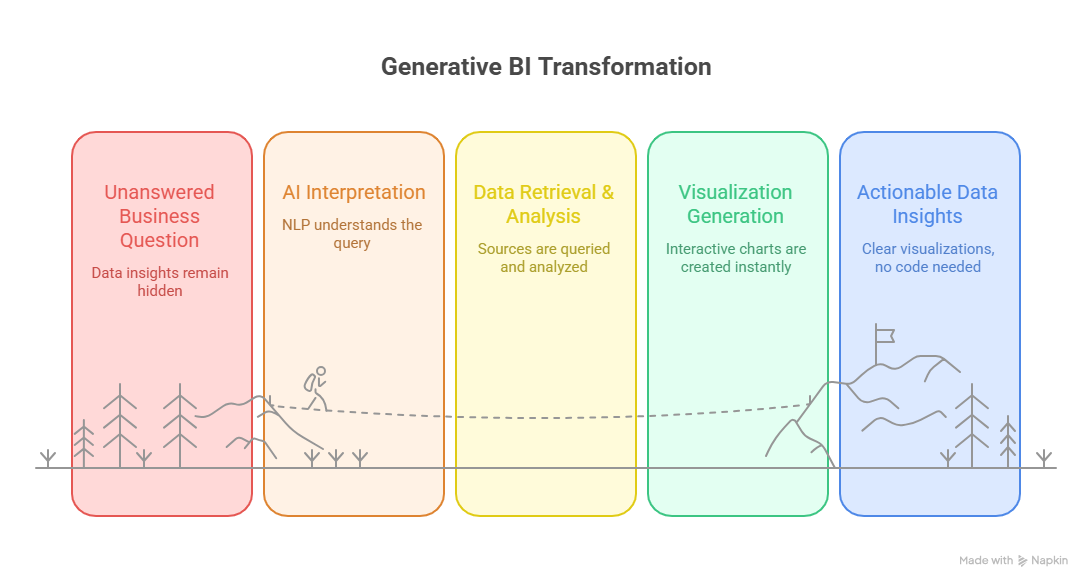
Natural Language Understanding (NLU)
- The system interprets user queries in natural language
- It identifies intent, entities, and context
- Advanced systems can handle ambiguity and clarify questions
Query Translation
- Natural language is converted to structured database queries
- The system maps business terms to technical data fields
- Context from previous interactions is maintained
Data Retrieval and Processing
- Relevant data is extracted from connected sources
- Statistical analysis and calculations are performed
- Results are prepared for presentation
Insight Generation
- AI identifies patterns, trends, and anomalies
- Contextual information is added to raw data
- Relationships between different data points are established
Visualization and Narrative Creation
- Appropriate visualization types are selected based on data
- Charts, graphs, and dashboards are automatically generated
- Natural language explanations accompany visual elements
Continuous Learning
- The system learns from user interactions
- Frequently asked questions are optimized
- Personalization based on user preferences and behavior
Generative BI Use Cases
What is the difference between generative AI and generative BI?
Generative AI
Definition
Technology that can create new content (text, images, audio, video) based on patterns learned from training data
Primary Function
Content creation and generation
Applications
Creative content production, chatbots, virtual assistants, content summarization
Examples
ChatGPT, DALL-E, Midjourney, Stable Diffusion
Generative BI
Definition
The use of generative AI in business intelligence and data analytics.
Primary Function
Data analysis, visualization, and insight generation
Applications
Natural language querying of databases, automated dashboard creation, data storytelling
Examples
IBM Watson Analytics, Narrative Science, ThoughtSpot, Tableau Ask Data
What is the future of AI in BI?
Emerging Trends
Agentic AI Development
- Autonomous planning capabilities for data analysis
- Complex task execution without human intervention
- Multi-step decision making based on business objectives
Multimodal Analytics
- Integration of text, voice, image, and video data
- Cross-format insight generation
- Unified analysis across structured and unstructured data
Collaborative Intelligence
- AI systems that work alongside human analysts
- Augmented analytics that enhance human capabilities
- Feedback loops that improve both human and AI performance
Embedded Analytics Everywhere
- BI capabilities integrated into everyday business applications
- Contextual insights delivered at the point of decision
- Ambient intelligence that anticipates information needs
Market Projections
Will data visualization be replaced by AI?
Evolution, Not Extinction
Automated Visualization Selection
- AI determines the most appropriate visualization type based on data characteristics and question context
- Human analysts focus on interpretation rather than creation
- Visualization quality and relevance improve through machine learning
Interactive and Adaptive Visuals
- Visualizations respond dynamically to follow-up questions
- Charts and graphs evolve based on user interaction
- Personalized visual preferences are learned and applied
Narrative-Enhanced Visualization
- AI-generated explanations accompany visual elements
- Key insights are highlighted automatically
- Context and implications are provided alongside raw data
Multimodal Presentation
- Visual, textual, and even audio explanations work together
- Different presentation modes for different learning styles
- Seamless switching between visualization types
Industry-Specific Applications of Generative BI
Financial Services
Healthcare
Retail and E-commerce
Manufacturing
Government and Public Sector
Implementation Guide: Getting Started with Generative BI
Assessment and Planning
- Evaluate existing data infrastructure and quality
- Identify key business questions that would benefit from generative BI
- Define success metrics and expected ROI
- Secure executive sponsorship and stakeholder buy-in
Data Preparation
- Clean and standardize data across sources
- Develop comprehensive data dictionaries and business glossaries
- Establish data governance policies
- Ensure data security and compliance measures are in place
Tool Selection
- Integration capabilities with existing data sources
- Natural language processing capabilities
- Customization options for your industry and use cases
- Security features and compliance certifications
- Vendor track record and support options
Pilot Implementation
- Select a specific department or use case with high potential value
- Define clear success criteria
- Allocate dedicated resources for implementation and training
- Plan for a 3-6 month pilot phase with regular evaluation
Training and Adoption
- Develop role-specific training programs
- Create internal champions to promote adoption
- Provide ongoing support and resources
- Celebrate and share early wins to build momentum
Scaling and Optimization
- Document lessons learned from the pilot
- Develop a phased rollout plan
- Continuously monitor performance and user feedback
- Regularly update and refine the system based on usage patterns
Common Implementation Challenges
FAQ's
No, AI is making BI more powerful and accessible, but human expertise remains crucial.
Generative BI can complement or enhance existing tools, but most organizations will use both for different tasks.
Leading generative BI tools follow enterprise-grade security standards and support audit trails and compliance.
Managers, analysts, executives, and operational teams can all leverage instant insights.
Identify core use cases, clean your data, choose your platform, and pilot with clear success metrics. We are here to help. Get a Free Demo Now!
Previous guide
Next guide
See GenBI working on your data in 30 minutes
Free personalised demo. Live walkthrough on your stack. Pricing covered openly. No card, no commitment.