MCP Connects AI to Your Business Systems. But Does It Solve the Enterprise Data Problem?
MCP Is Making AI More Connected. But Is Connected Data the Same as Usable Data?
The enterprise AI conversation is moving quickly from:
“Can AI answer questions?”
to:
“Can AI actually work with our business systems?”
That's where Model Context Protocol (MCP) is becoming increasingly important.
MCP gives AI applications a standardized way to discover and interact with external tools, resources and data. Instead of building a separate integration pattern for every AI application and every business system, MCP provides a common protocol for connecting models to those systems.
For businesses, that means an AI assistant can potentially interact with systems such as:
- ConnectWise
- Microsoft Dynamics / Business Central
- Salesforce
- ServiceNow
- ERP systems
- CRM platforms
- PSA platforms
- Databases and internal applications
Imagine asking an AI agent:
“Show me the customers with increasing support costs.”
The agent could potentially retrieve information from a PSA.
Or:
“Which customers are overdue on invoices?”
It could query an ERP.
Or:
“Update the opportunity stage.”
It could potentially take action inside a CRM.
That's powerful.
And MCP is becoming much more production-oriented.
The July 2026 MCP update matters
The July 28, 2026 MCP specification introduced several important changes, including a stateless protocol core, improved routing, cacheable list results, multi-round-trip requests, authorization hardening, an extensions framework and support for long-running tasks. The changes are designed to make MCP deployments more scalable and easier to operate on standard HTTP infrastructure.
This is an important evolution.
MCP is moving beyond being simply a convenient way to connect an AI assistant to a tool.
It is increasingly becoming infrastructure for agentic workflows.
But there's an important distinction:
Connecting AI to business systems is not the same thing as making enterprise data ready for AI-driven analytics.
And that's where the next problem begins.
What MCP Gives You, and What It Doesn't
MCP defines primitives for exposing tools, resources, and prompts to AI applications. Tools can allow models to retrieve information or perform actions through connected systems.
But organizations often make a second assumption:
“If AI can access all our systems, then we have solved our enterprise data problem.”
The gap isn’t access — it’s context. Analytify turns the data across your CRM, ERP and PSA into a governed, analytics-ready layer AI can trust. See it in a demo →
Not necessarily.
Here's the distinction.
| What the company thinks MCP gives them | What they may still be missing |
|---|---|
| “AI can connect to ConnectWise.” | Historical, analytics-ready ConnectWise data |
| “AI can query Business Central.” | A unified ConnectWise + Business Central data model |
| ““An AI assistant can answer questions.”” | Governed KPI and business definitions |
| “We don't need a warehouse anymore.” | Reliable cross-system joins and historical data |
| “The agent can call APIs live.” | Consistent performance at analytical scale |
| “We have an MCP server.” | Data quality and monitoring |
| “AI can retrieve current records.” | Snapshots, trends, and point-in-time analysis |
| “AI can take actions.” | Controls around sensitive or destructive actions |
In other words:
MCP standardizes how AI applications can discover and interact with tools, resources, and data sources.
It doesn't automatically solve:
It does not, by itself, solve data modeling, historical storage, metric governance, data quality, or analytical performance.
The Difference Becomes Clear With Real Questions
The biggest issue: operational systems weren't designed to be your analytics layer
Suppose an MSP has:
ConnectWise→ tickets, agreements, companies, technicians, projects
Business Central→ invoices, GL, payments, revenue, costs
They put an MCP server in front of both.
Now they ask:
“Which customers had declining gross margin for three consecutive months, while ticket volume increased more than 20%, SLA performance deteriorated, and outstanding invoices exceeded 60 days?”
MCP can technically give an AI the ability to call both systems.
But someone still has to figure out:
Customer ID in ConnectWise↕Customer ID in Business Central
plus:
ticket definitionrevenue definitionlabor-cost calculationSLA logicinvoice aging logiccalendar logichistorical snapshotscurrency handlingduplicatesdeleted recordsAPI paginationrate limitspermissions.
That's the hard part.
MCP standardizes how an AI application discovers and calls resources/tools. Its original purpose was precisely to create a common way for AI systems to connect to business tools and data sources.
“It does not inherently create the semantic, modeling, and governance layer needed to interpret data consistently across those systems.”
And this is where the architecture changes.
The Six Practical Data Problems MCP Doesn't Automatically Solve
1. Live API querying can become slow and expensive
For a simple question:
“Show me ticket #23489.”
An MCP connection to ConnectWise can be extremely useful.
But consider:
“Analyze three years of ticket history across 200 customers and identify the relationship between ticket volume, technician utilization, SLA breaches and customer profitability.”
That's a very different workload.
You generally do not want an AI application repeatedly making thousands of operational API calls to reconstruct an analytical dataset every time an executive asks a question.
A more scalable architecture is usually:
Operational Systems → Data Platform → Analytics / AI
MCP can still play a role at the interaction and action layer.
But analytical workloads need an appropriate data foundation.
2. Cross-system data is where things get difficult
MCP can make:
AI → System A
and:
AI → System B
much easier.
But the business question is often:
System A + System B + System C → one answer.
That's harder.
For example:
ConnectWise
Customer → ABC Ltd.
Business Central
Customer → ABC Limited
CRM
Account → ABC Ltd UK
Are these the same customer?
A human may know.
A reliable analytics system needs a defined relationship.
Without that, AI can produce an answer that sounds convincing but is based on incomplete or incorrectly joined information.
3. Historical state is often missing
Operational systems are primarily designed to answer:
What does the record look like now?
Business leaders often ask:
What did it look like then?
For example:
- What was ARR on January 31?
- Which customers moved from healthy to at-risk?
- How has ticket backlog changed over the last 12 months?
- What was technician utilization before we hired five engineers?
- Which customers experienced declining profitability over three quarters?
- How did our pipeline change before the revenue decline?
These questions require historical data, snapshots, CDC or another persistent data strategy.
MCP doesn't automatically create history that the underlying operational system doesn't retain.
4. AI-generated calculations can become inconsistent
Imagine three executives ask:
“What is our gross margin?”
One AI workflow calculates:
Revenue − labor cost
Another calculates:
Revenue − labor − software costs
Another calculates:
Revenue − COGS
All three answers could sound reasonable.
But which one is the company's official definition?
This is where a semantic layer and governed metrics become important.
The business should be able to define:
Gross Margin = approved business calculation
once.
Then dashboards, AI assistants and other analytical experiences can use that same definition.
5. Data quality doesn't disappear because AI is involved
An MCP server doesn't automatically fix:
- Duplicate customers
- Missing values
- Incorrect mappings
- Inconsistent naming
- Broken relationships
- Deleted records
- API inconsistencies
- Currency differences
- Time-zone problems
- Data freshness issues
AI can make access easier.
But bad data can still produce bad answers.
And because AI answers are conversational and confident, poor data quality can become harder for users to notice.
6. Read access is different from analytical and operational control
There is another important distinction.
An AI agent might be allowed to:
“Show me overdue invoices.”
That's one level of access.
But what happens when someone asks:
“Email all customers with overdue invoices.”
Or:
“Change these opportunity stages.”
Or:
“Cancel these customer accounts.”
Now you're moving from:
retrieval → recommendation → action.
That requires additional controls around:
- Authorization
- User identity
- Permissions
- Auditability
- Read vs. write access
- Approval workflows
- Tenant boundaries
- Agent identity
- Destructive actions
The July 2026 MCP release strengthened authorization, and the MCP roadmap continues to prioritize agent identity and enterprise-ready security as the ecosystem evolves.
So Where Does Analytify Fit?
Instead of thinking about this as:
MCP vs. Analytify
think about it as:
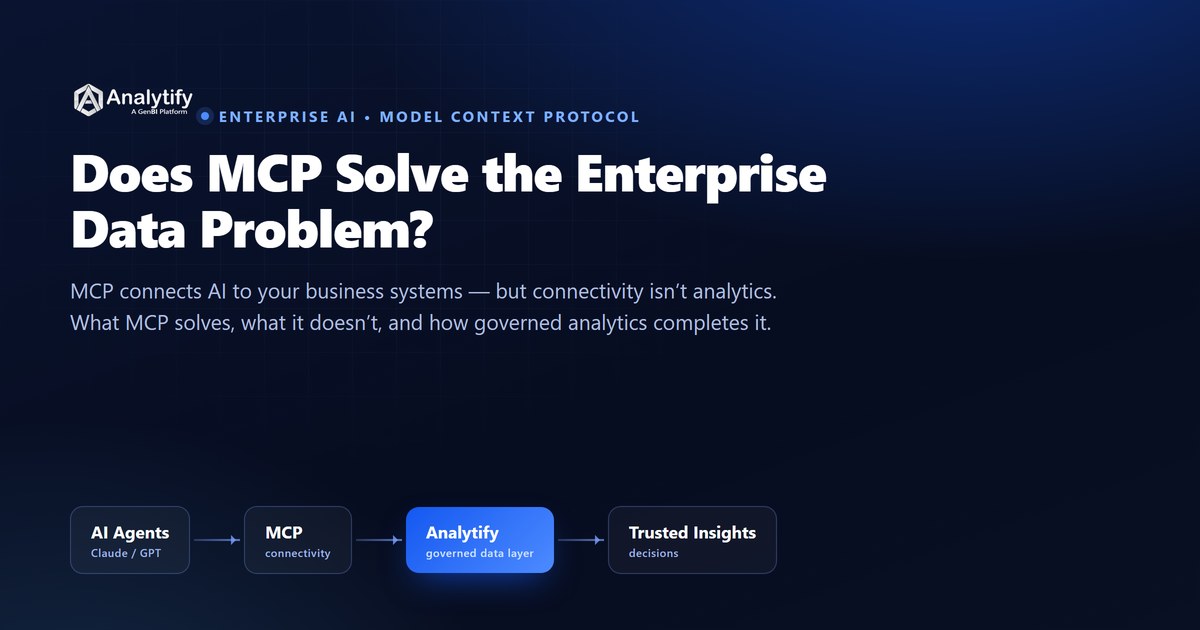
MCP connects AI to applications. Analytify turns the data across those applications into a trusted intelligence layer.
MCP is about making systems accessible to AI.
Analytify is about making the data across those systems usable for analytics and decision-making.
That means the two can work together.
Think of the difference this way:
MCP
“Here is a way for the AI to interact with this system.”
Analytify
“Here is the governed analytical context that helps the AI understand what the data means.”
That distinction becomes increasingly important as organizations connect more systems to AI.
A founder's perspective
“MCP is solving an important part of the enterprise AI puzzle: giving AI a standardized way to interact with the systems where work happens. But access alone isn't intelligence. When data is spread across CRMs, ERPs, PSAs and other operational systems, businesses still need a trusted layer that brings that data together, preserves history, governs metrics and makes it analytically useful. We see MCP and analytics working together—not competing with each other.”
This is the key positioning:
Don't fight MCP. Build around it.
The Architecture: MCP + Analytify
This is the architecture we believe makes the most sense for enterprises:
The important point is that MCP and Analytify are not necessarily competing layers.
They can serve different purposes.
MCP can provide the connection between AI and operational applications.
Analytify can provide the analytical foundation for understanding data across those applications.
MCP + Analytics: A More Complete Enterprise AI Architecture
This is where we believe the opportunity gets interesting.
Instead of every AI agent independently connecting to every operational system and figuring out the relationships each time, organizations can establish a shared intelligence layer.
This creates a separation of responsibilities.
Operational systems remain the systems of record.
MCP provides a standardized way for AI to interact with applications and tools.
Analytify can provide the analytical layer that brings data together for reporting, analytics and AI-driven business intelligence.
Why This Matters for Enterprise AI
The more systems an organization connects to AI, the more important the underlying data architecture becomes.
More connections don't automatically mean more intelligence.
A company might have:
CRM + ERP + PSA + Support + Billing + Product Analytics + HRIS
and still struggle to answer a basic executive question.
Why?
Because the problem isn't always access.
It's context.
Historical data matters
AI shouldn't only answer:
“What is happening now?”
It should help answer:
“Why did it happen?”
“How has it changed?”
“What is likely to happen next?”
“Which customers are becoming less profitable?”
Those questions depend on historical context.
Cross-system data is where things get difficult
The most valuable business questions rarely belong to one application.
They cross systems.
For example:
“Which customers are likely to churn?”
may require:
CRM
- customer activity
- support tickets
- product usage
- billing
- contract information.
No single operational system necessarily contains the complete answer.
Governance matters
An AI system can generate an answer quickly.
An enterprise needs to know:
Can we trust the answer?
That means knowing:
- Where did the data come from?
- Which definition was used?
- When was the data refreshed?
- Which users can access it?
- Can the result be audited?
- Does the answer respect business rules?
This is where governed analytics becomes important.
What About Security?
MCP makes AI-to-system connectivity more standardized, but enterprise security doesn't disappear.
In fact, as AI agents become capable of taking actions, the security model becomes more important.
Organizations need to consider:
Authentication
Who is the user or agent?
Authorization
What is the agent allowed to access?
Data permissions
Which customers, accounts or records can it see?
Read vs. write permissions
Can the agent only retrieve information, or can it modify records?
Auditability
Can the organization see what the agent accessed and what actions it performed?
Agent identity
What happens when the AI agent itself—not a human sitting at a browser—is making the request?
The MCP ecosystem is actively working on these areas. The July 2026 specification introduced additional authorization hardening, while the subsequent roadmap identified agent identity and enterprise-ready security as priority areas.
For enterprises, the lesson is simple:
AI connectivity needs to be governed just like any other enterprise access layer.
The Future Isn't MCP vs. Analytics
The conversation shouldn't be:
“Should we use MCP or BI?”
It should be:
“How do we make our business systems and business data work together for AI?”
MCP is making it easier for AI agents to interact with business applications.
Analytics platforms provide the structure needed to understand the data generated across those applications.
And organizations will increasingly need both.
Think about a future MSP.
A CEO asks:
“Why did our gross margin decline this quarter?”
The AI could use the analytical layer to understand:
- Revenue
- Labor costs
- Ticket volumes
- Technician utilization
- Customer profitability
- Contract margins
- Invoice aging
- Historical trends
Then the CEO asks:
“Which customers are responsible?”
The system identifies the accounts.
Then:
“Show me the five customers with the biggest deterioration.”
The analytical layer produces the analysis.
And finally:
“Create follow-up tasks for the account managers.”
That's where operational AI and MCP-enabled actions can come into play.
The value isn't coming from MCP alone.
And it isn't coming from analytics alone.
It's the combination.
The Bottom Line
MCP is solving a very real problem:
How can AI interact with the systems where business data and business processes live?
That's a major step forward.
But enterprise AI needs more than connectivity.
It needs:
trusted data
historical context
cross-system relationships
governed metrics
data quality
security
analytics at scale
and ultimately:
a reliable intelligence layer.
That's where platforms like Analytify can fit into the architecture.
The goal isn't to replace MCP.
The goal is to make the data behind AI more structured, governed and useful.
MCP connects AI to applications. Analytify turns the data across those applications into a trusted intelligence layer.
Book an Analytify demo to see how AI-powered analytics, governed metrics and cross-system data can fit into your existing data architecture. Analytify's current demo page offers a walkthrough around analytics, integration, security, multi-tenancy and deployment options.
Make the data behind your AI trustworthy
See how Analytify’s governed metrics, historical context and cross-system data fit into your existing architecture — alongside MCP, not against it.
Book an Analytify demoFrequently Asked Questions
What is MCP?
Model Context Protocol (MCP) is an open protocol that standardizes how AI applications interact with external tools, resources and data sources. It can allow AI models to retrieve information and perform actions through connected systems.
Does MCP replace a data warehouse?
Not necessarily.
MCP provides a standardized interaction layer for AI. It does not inherently provide the historical storage, transformation, cross-system modeling or analytical performance that organizations may need for enterprise analytics.
Does MCP solve cross-system analytics?
Not by itself.
MCP can make it easier for an AI application to access multiple systems. But organizations still need reliable relationships, definitions, transformations and governance across those systems.
Can MCP access systems such as ConnectWise, Salesforce and ERP platforms?
Yes, MCP can be used to expose tools and resources from external systems through MCP servers. The exact capabilities depend on the MCP server and the underlying application's APIs and permissions.
Is MCP only for reading data?
No.
MCP tools can be used for retrieving information as well as performing actions. That makes authorization, permissions and governance especially important for enterprise deployments.
Does MCP create historical data?
No.
If the underlying operational system doesn't provide the historical state required for an analysis, MCP doesn't automatically create that history. Organizations may need persistent storage, snapshots or change-data-capture strategies.
Why does a semantic layer matter for AI?
A semantic layer can establish consistent definitions for business metrics.
For example, instead of allowing different AI workflows to calculate “gross margin” differently, an organization can establish one governed definition that analytical experiences use consistently.
Can MCP and Analytify work together?
Yes.
They solve different problems.
MCP connects AI agents to applications and tools.
Analytify provides an analytics and intelligence layer for data across business systems.
Together, they can form part of a broader enterprise AI architecture.
Is MCP becoming an enterprise protocol?
MCP is evolving toward production and enterprise use. The July 28, 2026 specification introduced significant changes around stateless operation, routing, authorization, caching and long-running tasks. The MCP roadmap also identifies agent identity and enterprise-ready security as ongoing priorities.
What should enterprises consider before connecting AI to operational systems?
At minimum:
- Data quality
- Historical data
- Cross-system relationships
- Metric governance
- Authentication
- Authorization
- Agent identity
- Read/write permissions
- Auditability
- API limits and performance
- Human approval for sensitive actions