How AI-Driven Business Intelligence Is Reshaping Decision-Making
In today’s volatile global market, business leaders face an overwhelming data-to-decision latency. The sheer volume and velocity of information, from global supply chain fluctuations to real-time customer sentiment, mean that by the time traditional reporting delivers an insight, the opportunity has often passed. The core pain point is not a lack of data, but a crushing lack of speed and context. Competitive advantage now belongs to those who use AI-driven business intelligence to instantly filter noise and generate real-time, actionable insights that drive proactive strategy.
For years, high-value decision-makers, business leaders and senior business analysts alike, have been chained to a frustratingly slow cycle: pulling historical data, massaging spreadsheets, waiting for IT to run complex queries, and finally getting a report that is often outdated before it hits their desk. The legacy approach is time-consuming, expensive, and fundamentally reactive.
As we move toward 2026, the global economy isn’t waiting. The competitive edge belongs to organizations that can move from analyzing what happened to predicting what will happen and, most importantly, why. This strategic shift is only possible through the convergence of artificial intelligence and business intelligence, a movement we call AI-Driven BI.
For many organizations, the primary pain point in leveraging data remains achieving demonstrable return on investment (ROI) and managing data complexity. While AI adoption is high, with McKinsey reporting that over 78% of organizations use AI in at least one business function, many still struggle to scale its impact. Traditional BI systems fail under the weight of massive, unstructured data sets (social feeds, sensor telemetry, voice transcripts). AI algorithms resolve this by autonomously categorizing, sentiment-analyzing, and synthesizing vast information oceans. For example, AI platforms can analyze thousands of support interactions to predict equipment failure rates, enabling a strategic shift from costly reactive repairs to profitable predictive maintenance.
This post breaks down the current market environment and provides a strategic roadmap for adopting the intelligent systems necessary to compete.
What is AI-Driven Business Intelligence?
AI-driven business intelligence blends machine learning (ML), natural language processing (NLP), and generative AI (GenAI) into traditional BI systems to deliver smarter, faster, and more automated insights. It enables decision-makers to move from descriptive analytics (“what happened?”) to predictive (“what will happen?”) and prescriptive (“what should we do next?”).
In short, it’s no longer about looking back at the numbers, it’s about looking ahead with intelligence.
How AI-Driven BI Works
AI-driven BI fundamentally redefines how data is explored, interpreted, and acted upon. Instead of spending hours cleaning data or building reports, AI handles the heavy lifting behind the scenes, so teams can focus on strategy, not spreadsheets.
Accelerates speed and efficiency: By automating repetitive and complex data tasks, AI business intelligence tools cut analysis time from hours to minutes, delivering insights while the opportunity still matters.
Empowers everyone with data access: Intuitive, conversational business intelligence lets even non-technical users explore data independently, eliminating dependency on analysts and enabling a true culture of self-service analytics.
Uncovers hidden connections: AI sifts through millions of data points to identify subtle patterns, correlations, and trends that humans often overlook, revealing insights that can unlock entirely new growth opportunities.
Goes beyond “what happened” to “what’s next”: Traditional BI stops at historical reporting. AI-powered business intelligence adds predictive and prescriptive layers, forecasting future scenarios and suggesting the best course of action to achieve business goals.
In short, it turns your BI system into a thinking partner, one that continuously learns from your data and guides smarter decisions across every level of the organization.
The Role of AI in Business Intelligence
AI acts as the analytical brain behind BI systems.
It:
- Automates repetitive analysis
- Uncovers correlations humans might miss
- Delivers real-time insights
- Generates narratives that explain results clearly
- Continuously learns from data to improve future recommendations
AI-Driven BI vs. Traditional BI: The Critical Comparison
The transition from traditional BI to AI-driven BI is driven by the fact that legacy systems are creating measurable roadblocks for business agility. Here’s how they compare:
| Legacy BI Pain Points | AI-Driven BI Gains |
|---|---|
| High Hidden Costs: Expensive licensing, heavy infrastructure, and reliance on specialized data engineers | Cost-Effective & Scalable: Cloud-native architecture flexes with data volume, reducing maintenance overhead |
| Slow Insights: Weeks waiting for complex reports, limited real-time data refresh | Instant Real-Time Insights: Data analyzed instantly, allowing for proactive, moment-to-moment decisions |
| Complex & Technical: Requires SQL or specialized tool training, primarily for technical users | Conversational & Self-Service: Accessible to everyone via plain language queries |
Key Benefits of AI-Driven Business Intelligence
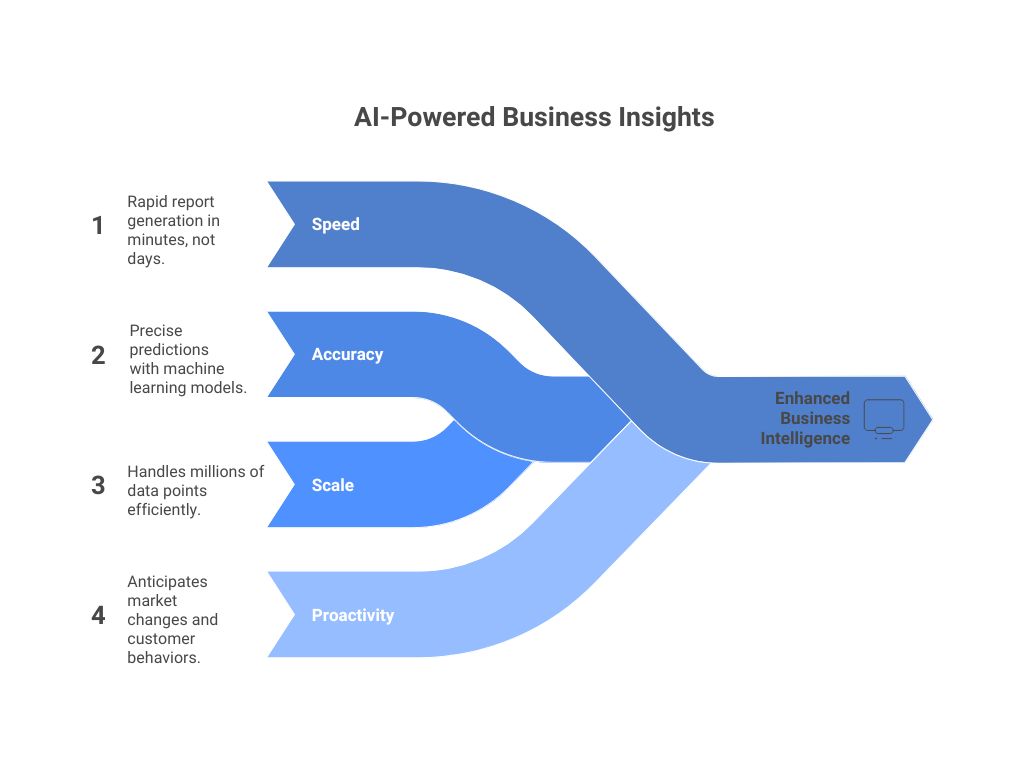
Real-Time, Automated Insights: AI eliminates manual data processing, delivering immediate insights and alerts so organizations can react quickly to changes or opportunities.
Predictive and Prescriptive Analytics: Not only can artificial intelligence business analytics predict future trends and outcomes using past and current data, but it also recommends optimal actions for the business to take.
Democratized Analytics: Non-technical users can access data and gain relevant insights through natural language queries and intuitive dashboards. No advanced analytics skills are required.
Enhanced Forecasting Accuracy: AI processes large and complex datasets with accuracy, improving forecasting for everything from sales to inventory and staffing.
Deeper Pattern Recognition: Uncovers hidden correlations, anomalies, and behavioral patterns that traditional BI often misses, unlocking new growth and optimization opportunities.
Automated Reporting and Storytelling: AI business intelligence tools automatically generate reports and plain-language narratives, speeding up decision cycles and making data actionable for all stakeholders.
Improved Operational Efficiency: Automates repetitive tasks (like data cleaning, report generation, and routine process monitoring), freeing up valuable human resources for creative or strategic work.
Business Agility: AI in business intelligence enables organizations to adapt quickly to market changes with real-time data, faster insights, and proactive recommendations.
Risk Detection and Fraud Prevention: AI-powered BI tools can spot anomalies and risks, such as security threats or unusual transactions, much faster and more accurately than manual review.
Competitive Advantage: Early and effective adopters of AI-driven BI enjoy stronger positioning through smarter, faster, and more precise decision-making.
Organizations that delay adoption risk falling behind competitors who are already leveraging these capabilities to optimize operations, personalize customer experiences, and identify new revenue opportunities. The gap between early adopters and laggards widens exponentially as AI-powered systems compound their learning advantages over time, making immediate action essential for maintaining market relevance.
These benefits collectively result in smarter strategies, more responsive operations, and significant time and cost savings for organizations leveraging AI-driven business intelligence.
Key Ways AI Is Reshaping Decision-Making
AI is transforming decision-making from reactive to predictive and prescriptive. Here’s how:
Automated Data Analysis: AI surfaces trends, anomalies, and correlations instantly, eliminating the manual effort traditionally required to identify patterns.
Natural Language Insights: Users can simply ask, “Which region had the highest sales growth?” AI-driven BI tools now use data storytelling and explainable AI to turn complex analytics into clear, human-readable narratives.
Real-Time Alerts and Anomaly Detection: AI-driven BI doesn’t wait for the next weekly review to highlight problems. It continuously monitors data streams and sends proactive alerts, get notified when something unusual happens, like a sales drop or cost spike.
Personalized, Role-Based Insights: Not all insights are relevant to everyone. AI understands user behavior, priorities, and objectives to deliver tailored insights that matter most to each role.
Cognitive and Prescriptive Decision Support: AI doesn’t just surface data, it assists in decision-making itself. AI’s cognitive models learn from past decisions and continuously improve future recommendations through scenario simulations that let you test “what-if” situations before making a move.
Empowering Employees with Embedded AI Assistants: The democratization of data science capabilities continues accelerating through embedded AI assistants that transform every employee into a data analyst.
The statistic that 92% of data workers spend time on operational tasks outside their roles reveals a critical inefficiency. AI-powered BI tools dissolve this bottleneck through automated data preparation and self-service capabilities. Business users can now generate reports and dashboards independently, freeing data teams to focus on strategic initiatives rather than routine request fulfillment.
Real-Time Decision Intelligence for Agile Responses: Real-time decision intelligence platforms are replacing traditional batch-processing systems, processing streaming data from IoT devices, social media feeds, and transactional systems simultaneously.
Multimodal AI for Comprehensive Analysis: The integration of multimodal AI capabilities allows BI systems to analyze not just structured data but also images, videos, audio recordings, and unstructured text documents within unified analytical frameworks. This holistic approach provides richer context for decision-making, capturing insights that traditional data sources miss entirely.
Harnessing Generative AI: The use of generative AI is becoming increasingly prevalent across various sectors. This technology enables businesses to create new content and insights from existing data, thereby enhancing creativity and innovation in decision-making processes.
Human + AI Collaboration: Leaders get AI-generated insights but make final calls using judgment and experience, combining the best of machine intelligence with human wisdom.
AI is transforming the way business leaders think, plan, and act. The outcome? Decisions are faster, better informed, and strategically aligned.
AI-Powered Innovations and Future Trends in BI
AI is not just enhancing BI, it’s revolutionizing how businesses interact with their data. Let’s explore the innovations shaping the next generation of analytics.
AI-Powered Innovations in BI Tools
Modern BI tools are becoming smarter, more intuitive, and increasingly autonomous. Key innovations include:
Natural Language Queries (NLQ): Ask your data questions in plain English like “Which region saw the highest profit growth last quarter?” and get instant answers.
Machine Learning Algorithms: These continuously analyze patterns within organizational data, identifying correlations and anomalies that human analysts might miss.
Deep Learning Models: Deep learning models process unstructured data sources, customer reviews, social media sentiment, call center transcripts, extracting valuable insights from information that traditional BI tools couldn’t interpret.
Auto Insights: AI scans datasets and highlights key patterns, anomalies, and opportunities without manual input.
Smart Dashboards: Dashboards now evolve dynamically, showing only the most relevant KPIs based on user roles, goals, and behavior.
Predictive & Prescriptive Analysis: Beyond explaining the past, these models help forecast outcomes and recommend next steps.
Future Trends in AI and BI
The next era of BI is even more exciting. As AI continues to evolve, we’ll see:
Generative BI: AI automatically builds dashboards, summaries, and data stories using generative algorithms, making analytics truly conversational.
Augmented Analytics: Human intuition meets AI automation, enabling users to validate, explore, and trust AI findings with greater transparency.
Conversational BI: Chat-like interfaces will replace complex report builders. Data analysis will be as simple as chatting with your BI assistant.
Edge AI Analytics: Processing data closer to the source will enable real-time insights for IoT, retail, and manufacturing operations.
The Future of AI in Business Intelligence
In the coming years, BI will no longer be a “support function”, it will be the decision nerve center of every organization.
AI will:
- Turn static dashboards into intelligent decision agents.
- Integrate seamlessly with business apps like CRM, ERP, and marketing tools.
- Enable continuous learning, adapting recommendations based on new data patterns.
Leaders and analysts who embrace AI early will not only make better decisions , they’ll define the standards of intelligent business.
How to Implement AI-Driven Business Intelligence
Moving to AI-driven BI isn’t just a tech shift, it’s a strategic transformation.
Step-by-Step Implementation Framework

Assess Your BI Maturity: Identify current gaps and data challenges in your existing infrastructure.
Define Clear Use Cases: Start with business problems, not tools. What specific decisions need to be faster or more accurate?
Choose the Right Platform: Look for AI-first BI tools with automation and NLP capabilities that integrate with your existing tech stack.
Integrate Your Data Sources: Break data silos to create a single source of truth across the organization.
Enable Your Teams: Train non-technical users to use AI insights confidently through workshops and hands-on sessions.
Monitor and Scale: Use feedback loops to refine models and improve accuracy, then expand to additional use cases.
Challenges in Implementing AI in BI
While the potential is huge, adoption comes with hurdles:
- Data quality and consistency
- Data security and privacy concerns
- Cost of infrastructure and implementation
- Resistance to change within the organization
- Need for clear governance and explainability
- Human and organizational challenges
- Transparency and accountability requirements
The key is to start small, select the right AI data visualization tool that evaluates compatibility with existing data infrastructure and matches your technical landscape, focus on ROI-driven use cases, and scale gradually.
How AI Improves Business Intelligence
AI supercharges BI in multiple ways:
- Automates analysis, saving hours of manual work
- Detects hidden patterns, uncovering insights humans often miss
- Enables real-time decisions, no more waiting for reports
- Personalizes insights, tailoring data stories for each role
- Enhances visualizations, turning raw data into intuitive stories
In short, AI doesn’t replace BI, it amplifies it.
Industry-Specific Use Cases and Real-Life Examples of AI-Powered Business Intelligence
The shift from manual reporting to automated intelligence is driving breakthrough results in key functional areas.
Sales & Lead Management
The goal of the sales organization is to focus on high-probability leads. AI-driven BI achieves this through:
Predictive Lead Scoring: AI models analyze thousands of data points (firmographics, engagement history, web activity) to prioritize leads most likely to convert. Companies leveraging these systems report up to a 32% increase in sales conversions and significant pipeline growth.
Enhanced Forecasting Accuracy: By integrating real-time market signals and historical performance, AI-driven demand forecasting eliminates guesswork, helping businesses like the iconic brand Harley-Davidson to boost overall motorcycle sales by nearly 30% in key markets where they deployed targeted AI lead generation.
Marketing & Customer Experience
Marketing is fundamentally about delivering the right message to the right person at the right time. AI makes this hyper-personalized approach scalable:
Hyper-Personalization at Scale: AI-powered personalization engines analyze individual customer behavior to tailor content and product recommendations instantly. Users who engage with these personalized experiences are often 3x more likely to convert.
Optimizing Spend: AI systems analyze campaign performance in real-time, instantly shifting budget allocation from underperforming ads to those showing the highest ROI potential. This results in more efficient use of marketing capital and a higher rate of customer acquisition.
Automated Customer Support: Generative AI-powered chatbots and customer service agents handle up to two-thirds of customer interactions, significantly reducing the workload for human staff and improving customer satisfaction scores (CSAT) due to faster, tailored responses.
Finance Industry Analytics:
The finance industry analytics landscape has experienced dramatic transformation through AI-powered business intelligence. Neobank Northmill provides a compelling example of this shift. The company deployed an AI analytics platform to investigate why potential customers abandoned their onboarding process. By analyzing customer behavior patterns in real-time, they identified specific friction points causing dropouts. The insights led to targeted process improvements that boosted conversion rates by 30%.
Financial institutions now leverage AI-driven BI for scenario simulation and decision impact assessment. These capabilities allow risk managers to model multiple economic scenarios simultaneously, evaluating potential outcomes before committing to strategic decisions. The technology processes vast amounts of structured and unstructured data, from market indicators to social media sentiment, creating a comprehensive view that traditional tools simply cannot match.
Retail Industry Analytics:
Retail industry analytics has evolved from basic sales reporting to sophisticated, granular analysis of every customer touchpoint. Fabuwood, a luxury kitchen manufacturer, implemented interactive retail Liveboards to gain unprecedented visibility into their sales operations. The platform enabled their team to track performance across the entire sales pipeline, from lead generation through deal closure.
AI-powered analytics platforms now deliver:
- Real-time identification of high-performing sales regions and underperforming territories
- Promotional strategy impact analysis that measures campaign effectiveness within hours rather than weeks
- Customer trend detection that reveals shifting preferences before they impact revenue
- Predictive inventory management based on historical patterns and external market factors
The technology empowers retail managers to drill down into specific metrics using natural language queries, eliminating the need for technical expertise or data team intervention.
Moreover, the integration of data science into these sectors further amplifies the benefits of AI-powered business intelligence. With data science, businesses can uncover deeper insights from their data, allowing for more informed decision-making and strategic planning.
The Impact of AI-Driven BI on Business Performance
Companies that adopt AI-powered BI report:
- 2–3x faster decision-making
- Up to 20% higher operational efficiency
- Better forecasting accuracy
- Reduced risk and improved compliance
- Greater employee confidence in data-led decisions
When every department makes decisions backed by intelligence, the business moves forward as one data-driven organism.
Quantifying the ROI: The Measurable Impact of Generative BI
The true measure of AI adoption is not just capability, but its tangible financial and productivity return. Enterprises that move strategically into generative BI are seeing immediate and measurable results across the board.
According to a 2023 global study by IDC, for every $1 companies invest in AI, they are realizing an average return of $3.50. Beyond revenue growth, the key ROI metrics center on efficiency and cost avoidance:
Productivity Boost: AI-driven automation leads to an average 40% increase in employee productivity by eliminating repetitive tasks like data cleaning, reporting, and summarization. This frees up high-value analysts to focus on strategic initiatives.
Operational Cost Reduction: By optimizing workflows and automating routine data management, companies can achieve up to a 40% reduction in operational costs.
Time-to-Insight Acceleration: Manual report generation that once took weeks is often reduced to minutes, allowing for true, moment-to-moment decision-making that capitalizes on fleeting market opportunities.
The Strategic Impact: Why Business Leaders Must Act Now
The market is currently separating into two camps: those whose decisions are slow and manual, and those whose decisions are real-time and predictive. For business leaders and senior business analysts, adopting AI-driven BI is the only way to move to the latter.
For Business Leaders: The focus shifts from operational reporting to strategic foresight. AI uncovers inefficiencies, identifies new market opportunities, and maximizes ROI by ensuring capital is only deployed where predictive models show success.
For Senior Analysts: AI automates the mundane, freeing up the analyst’s high-level cognitive skills. Instead of spending 80% of their time prepping data, they spend 80% of their time on deep, strategic problem-solving. This upskills the team and provides massive internal efficiency gains.
Discover Analytify.ai for AI-Powered Business Intelligence Solutions
When evaluating how to make this critical shift, you need a partner that understands AI-powered business intelligence, the ability for AI to converse and create meaningful, actionable content based on your data.
Analytify.ai was developed specifically to solve the legacy BI pain points of complexity, time, and cost. It’s a GenBI platform designed to be instantly usable by every level of your organization. It’s not just about creating reports faster; it’s about giving your business leaders a direct, conversational line to the answers hidden in your data, all while ensuring enterprise-grade security and scalability.
If the high cost and slow insights of your current system are preventing you from making real-time decisions, the logical next step is exploring a solution built for the future.
Ready for Real-Time Decisions? Request a personalized demo of Analytify.ai today.
Future-Proofing Your Business: The Road Ahead
The era of descriptive reporting is over. The competitive mandate for 2026 is clear: businesses must evolve from being data-aware to being truly data-driven by integrating artificial intelligence. This isn’t an optional upgrade; it’s the core engine of modern business agility.
Stop allowing outdated systems to limit your vision. Use AI to stop reacting to the past and start shaping the future. The organizations that embrace AI-driven business intelligence today will be the ones defining their industries tomorrow.
Don’t wait until 2026. Get a personalized demo of Analytify.ai and see how GenBI transforms your decision-making
See Analytify embedded inside a live SaaS product.
Get a 30-minute walkthrough. Open-source, multi-tenant, enterprise-ready.