How Generative AI is Changing Embedded Analytics: A Complete Guide
Generative AI embedded analytics is revolutionizing how we work with data. As companies scramble to make sense of their information, AI-powered embedded analytics has become essential rather than just nice to have. The way generative AI works with embedded analytics platforms is completely changing how businesses interact with data and turn it into real decisions.
The numbers tell an interesting story: the global embedded analytics market hit $69.60 billion in 2024 and experts predict it’ll reach $182.72 billion by 2033, growing at about 13% each year. What’s fueling this massive growth? Simple, AI-powered embedded analytics tools are making data work in ways we couldn’t imagine just a few years ago.
What AI-Powered Embedded Analytics Really Means Today
Let’s break this down. Embedded analytics solutions are basically data visualization and analysis features built right into the apps you already use every day. Instead of jumping between different programs to check your data, everything’s right there where you need it. Think of it like having a smart data analyst sitting inside every application your team touches.
Here’s the thing though, traditional embedded analytics platforms had some real problems. You still had to know exactly what questions to ask, figure out how to use complicated dashboards, and actually understand what all those charts meant. That’s where AI-powered embedded analytics flips the script, bringing in conversational BI so you can literally just talk to your data like you would a colleague.
How is Embedded AI Different from Traditional AI?
This is where things get interesting. There’s a huge difference between embedded AI solutions and the traditional AI setups most people are familiar with.
The Old Way of Doing AI
Traditional AI systems typically sit apart from your everyday work. You’d have to export your data, run your analysis in some separate tool, then bring the insights back into your workflow. Pretty clunky, right? These systems usually needed:
- Different logins and separate interfaces to learn
- Manually moving data back and forth
- Someone with technical chops to make sense of the results
- Constantly switching between different apps
- Complex setup and integration headaches
The Embedded AI Approach
AI-Driven Embedded Analytics works completely differently, it puts the intelligence right where you’re already working. This changes everything:
- Works Seamlessly: Analytics just appear in your existing tools without disrupting how you work
- Understands Context: The AI gets what you’re trying to do and what your role needs
- No Learning Curve: You use interfaces you already know, just supercharged with AI
- Real-Time Answers: Make decisions based on live data without any delays
- Everyone Can Use It: Doesn’t matter if you’re tech-savvy or not, it just works
Think about it this way: traditional AI is like having a data scientist in another building that you have to walk to every time you need something. Embedded AI is like having that intelligence woven right into the tools you use every single day.
What Makes GenAI Different in the Analytics World?
Generative ai data analytics software is changing the game for how people use embedded analytics platform tools. Natural language queries and automatic insight generation mean you can forget about SQL or hunting through endless dashboard menus. Just ask your question in plain English and get a straight answer.
Here’s what GenAI data analysis actually does for embedded analytics solutions:
1. Conversational BI That Gets What You Mean
Today’s AI-powered analytics tools understand context, can handle your follow-up questions, and will even ask for clarification if something’s unclear. Ask naturally, get answers instantly, that’s real self-service analytics.
Picture this: a sales manager doesn’t need to build some complicated report anymore. They just ask, “Which products aren’t doing well in the Northeast compared to last quarter?” The system answers the question, creates AI data visualizations automatically, and explains what’s actually causing the issues.
2. Insights That Come to You Instead of the Other Way Around
Here’s something cool, generative AI watches your data constantly and flags important stuff like emerging trends, potential problems, or opportunities you might miss. You don’t have to go digging for insights; they find you.
This is a real shift from waiting around for someone to discover something to having the system alert you before small issues become big problems. Modern AI analytics software spots anomalies, catches patterns, and gives stakeholders a heads up about important changes happening right now.
3. Personalized Recommendations Based on Who You Are
The AI knows your role, what you’re working on, and what matters to you. So a CFO gets alerts about budget variances, while a sales director sees notifications about pipeline changes. Same data, but presented in ways that make sense for each person.
4. Reports That Write Themselves with Explanations
Leading platforms use large language models to understand charts and handle GenAI data analysis, which means businesses can create summary reports automatically. This basically eliminates the manual work of analysis and report writing.
Imagine this: you connect a dataset to your embedded analytics platform and instead of just getting charts, you get a full story explaining what the numbers mean, why they matter, and what you should actually do about it. That’s what embedding AI-powered analytics can do.
Why AI-Powered Embedded Analytics Actually Matters
The benefits of implementing generative AI embedded analytics touch every part of how businesses operate:
Make Decisions Way Faster
Companies using AI powered embedded analytics make decisions 5x faster, that’s not a typo. Time to get insights drops by 80%, which means you can actually respond to market changes while they’re still relevant.
Everyone Gets Access to Data
Conversational BI removes the technical barriers, so every team member can query data and create reports without knowing SQL or having a data science degree. This means frontline employees can make smart, data-backed decisions on their own.
People Actually Use It
When analytics feel like a natural part of the apps people already use, adoption goes through the roof. By 2026, experts say 95% of data-driven decisions will be at least partly automated, which makes having an intuitive interface pretty crucial.
Saves Real Money
Cutting down on specialists for basic queries saves serious operational costs. AI-powered analytics tools handle the repetitive stuff automatically, freeing up your data team to work on strategic projects instead.
Grows Without Getting Complicated
Modern embedded AI solutions scale from hundreds to millions of users without slowing down. Your business can grow without having to proportionally increase infrastructure or hire to
Stay Ahead of Competitors
Organizations using generative ai data analytics software get strategic advantages through faster pattern recognition, predictive capabilities, and catching problems before they happen, things competitors using old-school tools just can’t match.
Real Stories from Different Industries
Financial Services: Catching Fraud and Managing Risk in Real-Time
Banks use AI-powered embedded analytics to detect fraud, monitor risks, and stay compliant with regulations. The system automatically spots weird transaction patterns and explains the risk factors in plain language so people can make quick decisions. Conversational BI lets compliance officers query transaction data naturally, like asking “Show me all wire transfers over $50,000 to high-risk countries this week.”
Healthcare: Better Patient Care and Smarter Operations
Healthcare providers use embedded analytics solutions to predict which patients might need readmission, optimize how they use resources, and figure out which treatments work best. Natural language interfaces let doctors quickly query patient data without wrestling with complex systems. AI data visualizations make complicated clinical data easy to understand right when you need it.
Retail and E-Commerce: Personalization That Scales
Retailers use AI-Driven Embedded Analytics to adjust prices and manage inventory across thousands of stores at once. AI algorithms look at buying patterns, seasonal trends, and outside factors to optimize inventory and personalize customer experiences in real-time. Embedded AI solutions power recommendation engines that boost conversion rates by 15-30%.
Manufacturing: Preventing Breakdowns and Maintaining Quality
Production facilities using embedded dashboards have improved how they schedule production by analyzing machine efficiency in real-time. AI systems predict when equipment might fail before it actually happens, cutting downtime and maintenance costs by up to 40%. GenAI data analysis catches quality issues before products reach customers.
Software Companies: Understanding Customers and Products Better
SaaS companies put analytics right into their platforms, giving customers powerful insights about their own data. This doesn’t just add value, it creates features that keep customers from leaving. Modern AI analytics software helps product teams understand how people use features and behave at a level that wasn’t possible before.
Marketing and Advertising: Making Campaigns Work Better
Marketing teams use AI-powered analytics tools to understand campaign performance across dozens of channels at once. Conversational BI lets marketers ask complex questions like “Which audience segments engaged better after we changed our messaging?” and get immediate, useful answers with supporting AI data visualizations.
How This Technology Actually Works
Modern AI-powered embedded analytics platforms combine several sophisticated pieces:
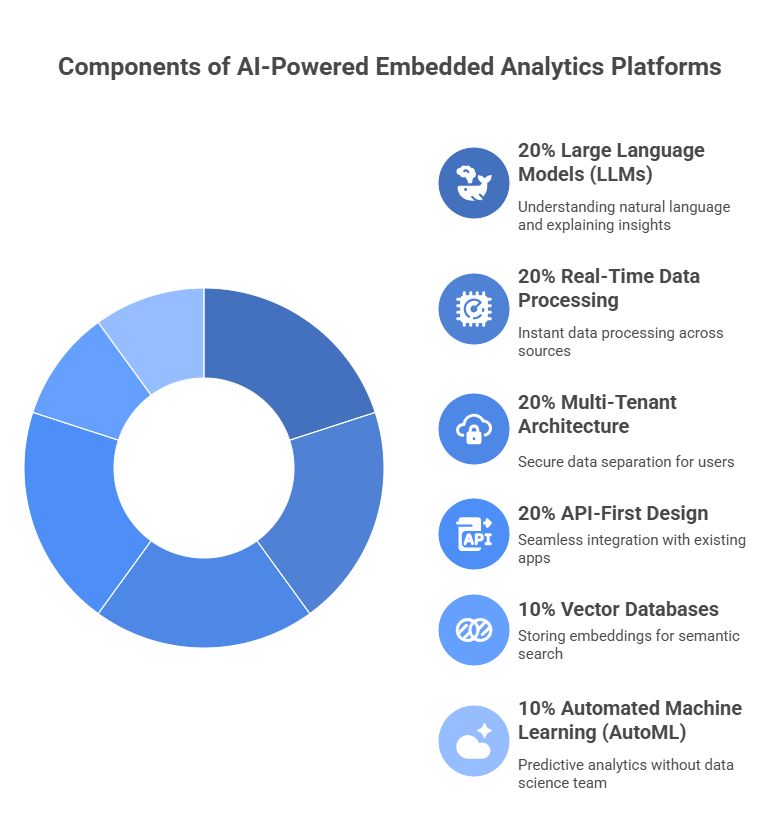
Large Language Models (LLMs): These handle understanding natural language, creating queries, and explaining insights in plain English. They translate your questions into database queries and turn the results into readable insights, making true conversational BI possible.
Real-Time Data Processing: Cloud-based setups process data instantly across multiple sources, so your insights always reflect what’s happening right now without any lag.
Multi-Tenant Architecture: Secure data separation means each user or organization only sees their authorized data while everyone shares the underlying infrastructure efficiently, super important for embedded AI solutions serving multiple clients.
API-First Design: Comprehensive APIs let you integrate seamlessly with existing apps and workflows, so you can embed AI-powered analytics into pretty much any software environment.
Vector Databases: These store embeddings that enable semantic search and similarity matching, letting users find relevant data even when they don’t know the exact technical terms.
Automated Machine Learning (AutoML): Enables predictive analytics without needing a data science team, making advanced analytics accessible across organizations.
Picking the Right Embedded Analytics Platform
With the embedded analytics market growing like crazy, choosing the right platform matters. Here’s what to look for:
Can It Connect to Your Stuff?
The platform needs to work seamlessly with your existing data sources, SQL databases, NoSQL systems, cloud warehouses like Snowflake or BigQuery, or REST APIs. Look for ready-made connectors and solid API support.
Can You Make It Look Like Yours?
For customer-facing applications, being able to customize everything to match your brand is crucial. Top embedded analytics solutions offer complete white-labeling, so your analytics feel like they’re part of your product.
Is It Secure and Compliant?
Make sure your chosen embedded analytics platform supports role-based access control, SSO, encryption, and compliance with regulations like GDPR, SOC 2, and HIPAA. Government support for data security is pushing adoption of embedded analytics solutions.
Will It Scale and Perform?
Vendors are competing to deliver optimized solutions that support multi-tenant environments. Your platform should handle growing data and more users without slowing down.
How Good Is the AI?
Test the conversational BI features. Can users really ask questions naturally? Does it understand follow-up questions and context? Try the natural language processing with your own data and real use cases.
What’s It Really Going to Cost?
Understand the total cost including implementation, user licenses, data volume charges, and support. Some platforms charge subscriptions while others use usage-based pricing.
Is It Easy for Developers?
APIs, SDKs, documentation quality, and community support significantly affect how fast you can implement and maintain things long-term. Pick platforms with strong developer communities.
Top AI-Powered Embedded Analytics Tools for 2026
1. Analytify AI
Analytify.ai is a modern AI-powered embedded analytics platform that brings together generative AI and intuitive visualization. Built for businesses that want to embed intelligent analytics without the usual complexity.
Why You Should Consider Analytify.ai:
- Create dashboards using natural language prompts, just describe what you want
- One-click “Generate Insights” automatically suggests charts and key metrics when you connect data
- Built on open-source so there’s no vendor lock-in
- Connects easily with major databases and cloud platforms including AWS, Azure, and Google Cloud
- GenieAIQ powered dashboard implementation for instant GenAI data analysis
What It Can Do:
Ask Questions Naturally: Business questions in plain English get instant answers with supporting visualizations
Automatic Insight Discovery: AI finds trends, anomalies, and opportunities in your data automatically
Embed However You Want: Put dashboards, reports, or entire analytics experiences into any application
Work Together in Real-Time: Teams can query data together, discuss what they find, and make decisions collaboratively
Connect Multiple Sources: Works with SQL databases, NoSQL systems, cloud warehouses, APIs, and spreadsheets effortlessly
Make It Your Own: Fully customizable to match your brand
Smart Visualizations: Automatically creates the best chart types based on your data
What It Costs:
Transparent, scalable pricing starting at competitive rates with no surprise fees. Enterprise plans available with custom features, dedicated support, and deployment options.
Perfect For: SaaS companies, data-driven enterprises, and organizations wanting to embed modern AI analytics software into customer-facing or internal applications without massive development effort.
Check it out: Embedded Analytics by Analytify.ai
2. ThoughtSpot Embedded
ThoughtSpot Embedded focuses on AI-driven, search-first analytics. Users type questions in natural language and instantly get interactive charts and insights.
What It Does:
- Natural language search (SpotIQ) for conversational BI
- AI-driven insights with automatic anomaly detection
- Interactive Liveboards with drill-down capabilities
- White-label embedding with full branding control
- Comprehensive APIs and SDKs for developers
Why Consider It: Great for self-service analytics with minimal training needed. Strong AI for finding insights automatically.
Pricing: Enterprise pricing typically starts around $95,000 annually. Custom quotes based on users and data volume.
Best For: Large enterprises needing self-service analytics with minimal training requirements
3. Upsolve.ai
Upsolve.ai is an embedded GenBI platform where users query data naturally. Instead of building static dashboards, you embed a component and users interact naturally with their data.
Features:
- Role-based dashboards that automatically adapt to user personas
- Natural language data queries for conversational BI
- Support for multiple stakeholders with personalized views
- Quick implementation using React/iFrame components
Why Consider It:
Fast implementation for customer-facing analytics where different users need different views. Strong focus on personalization.
Pricing: Custom pricing based on how you’re embedding it and what features you need.
Best For: Customer-facing analytics where user personas vary widely
4. Looker Embedded (Google Cloud)
Looker Embedded connects live to data sources like BigQuery for always-fresh metrics, with strong governance and deep embedding capabilities.
Features:
- API-first architecture for custom implementations
- Real-time data connectivity
- AI-powered workflows and auto-generated reports
- Enterprise-grade controls and compliance
- Works seamlessly with Google Cloud ecosystem
Why Consider It:
Perfect if you’re already invested in Google Cloud. Strong governance and security features.
Pricing: Starts around $3,000-$5,000 per month for basic deployments. Scales with usage.
Best For: Enterprises heavily invested in Google Cloud infrastructure
5. Sisense
A robust embedded analytics platform with advanced analytics, scalability, and lots of customization options plus AI-powered features for predictions and automated insights.
Features:
- Single-stack architecture for performance
- Advanced data mashup capabilities
- Embedded widgets for flexible integration
- AI-driven insights and forecasting
- Strong multi-tenant support
Why Consider It:
Powerful for complex analytics needs with high customization. Strong performance with large datasets.
Pricing: Enterprise-focused pricing, typically $100,000+ annually for embedded deployments.
Best For: Large enterprises requiring complex analytics with high customization
6. Power BI Embedded
Power BI Embedded uses pay-as-you-go capacity, scaling with demand and deeply integrated with Microsoft’s ecosystem.
Features:
- Seamless Azure and Office 365 integration
- Rich interactive visualizations
- AI Copilot for automated insights and conversational BI
- Comprehensive developer APIs
- Enterprise security with Azure AD
Why Consider It:
Best integration if you’re a Microsoft shop. Familiar interface for Office 365 users.
Pricing: Pay-as-you-go starting at $1/hour for A1 capacity. Monthly commitments available for savings.
Best For: Organizations already invested in the Microsoft ecosystem
7. Bold BI
Bold BI users can automatically get answers to queries, understand data trends, and generate insights faster through AI features, including Q&A widgets and AI assistants.
Features:
- Natural language query interface
- Automatic chart generation from prompts
- AI-powered textual summaries
- Scheduled report delivery
- Designer mode for customization
Why Consider It:
Comprehensive AI features with strong customization. Good balance of power and ease of use.
Pricing: Starts around $995/month for embedded deployments.
Best For: Organizations seeking comprehensive AI features with strong customization
8. Tableau Embedded
A powerful visualization platform with advanced embedded capabilities and deep AI integrations through Salesforce’s Einstein Copilot.
Features:
- Advanced visual design capabilities
- Cross-platform deployment flexibility
- AI-powered insights with Einstein
- Extensive visualization library
- Strong developer ecosystem
Why Consider It:
Industry-leading visualization capabilities. Excellent for creating compelling, interactive data stories.
Pricing: Embedded analytics licensing requires Tableau Creator licenses plus embedding fees. Typically $70+ per user/month.
Best For: Organizations prioritizing advanced visualizations and design
9. Knowi
A unified BI platform specializing in embedded analytics solutions with strong support for NoSQL and unstructured data, featuring AI-powered conversational interfaces.
Features:
- Natural language Q&A capabilities
- Chat with documents functionality
- Built-in ML models for classification and anomaly detection
- Multi-source data joins across SQL, NoSQL, and REST APIs
- White-labeling and multi-tenant architecture
Why Consider It:
Excellent for diverse data sources including NoSQL. Strong unstructured data handling.
Pricing: Custom pricing based on deployment scope and features.
Best For: Companies dealing with diverse data sources and unstructured data
10. Qrvey
A developer-friendly embedded analytics platform offering end-to-end embedded analytics with a strong focus on reducing engineering work.
Features:
- No-code/low-code dashboard builder
- Elasticsearch-powered performance
- Iframe-free embedding
- Complete white-label customization
- Multi-tenant architecture
Why Consider It:
Significantly reduces development work. Strong focus on easy implementation.
Pricing: Custom pricing, typically more affordable than enterprise platforms.
Best For: SaaS companies looking to reduce development overhead
Making It Work: Best Practices for Success
Start with Clear Goals
Figure out what specific problems you’re solving before picking an embedded analytics platform. Are you helping customers self-serve? Making internal decisions better? Creating a new revenue stream? Your goals determine which features actually matter.
Focus on User Experience
81% of tech leaders have noticed significantly more interest in embedded analytics. Design with your actual end-users in mind, making sure the interface feels natural to your application and the conversational BI features match how users naturally ask questions.
Get Your Data Right First
AI is only as good as the data feeding it. Set up data governance practices, standardize definitions, and maintain data quality before implementing AI-powered embedded analytics.
Think About Scale from Day One
88% of organizations are using AI somewhere in their business. Design your setup to handle growing data volumes and more users from the start.
Actually Measure Results
Define KPIs for your embedded analytics implementation. Track things like user adoption rates, time-to-insight, decision speed, and business outcomes influenced by data-driven decisions.
Train and Support Your Users
Even with conversational BI, users benefit from understanding what’s possible and how to use it well. Offer training on asking effective questions and interpreting AI-generated insights.
Getting Past Common Roadblocks
Integration Headaches
32% of users say legacy infrastructure is their biggest barrier to embedded analytics adoption. Choose embedded analytics solutions with ready-made connectors and solid API support to minimize integration pain.
Getting People to Actually Use It
29% see user adoption as the main challenge. Fight this with intuitive interfaces, natural language capabilities powered by AI-powered analytics tools, and good training programs.
Justifying the Cost
30% of users see cost justification as their main hurdle. Build a clear ROI model showing how faster decisions, less manual analysis, and better outcomes justify investing in AI-powered embedded analytics.
Security Worries
When AI is accessing sensitive data, security is critical. Implement strong access controls, encryption, and audit trails. Make sure your embedded analytics platform complies with relevant regulations and keeps data isolated in multi-tenant scenarios.
Trusting AI Results
Users need to trust AI-generated insights. Implement explainable AI features that show how conclusions were reached. Let users validate AI findings against raw data.
What's Coming Next for AI and Embedded Analytics
Edge Analytics
As IoT devices multiply, more analytics will happen at the edge, processing data right where it’s created for faster insights with less latency and bandwidth use.
Agentic AI
Organizations are seeing more agentic AI, where AI systems don’t just answer questions but actually take actions based on data insights with minimal human involvement.
Better Explanations
Explainable AI helps users understand and trust the insights. Future generative ai data analytics software will provide even clearer reasoning, showing exactly how it reached conclusions.
Multiple Data Types
Next-generation embedded analytics platforms will seamlessly work with structured data, documents, images, video, and audio, providing comprehensive insights across all data types through unified AI interfaces.
Working Together in Real-Time
AI will help teams explore data together, letting them collectively query data, discuss findings, and make decisions together within embedded analytics environments using conversational BI.
Ultra-Personalization
AI-Driven Embedded Analytics will become even more contextually aware, adapting not just to roles but to individual preferences, learning styles, and decision-making patterns over time.
Time to Get Started
The embedded analytics market is at a turning point. 88% of survey respondents say their organizations regularly use AI, and those not implementing AI-powered analytics risk falling behind competitors who are making decisions five times faster.
Here’s what to do:
1. Check Where You Are Now
Look at your current analytics capabilities, identify gaps, and define what success looks like for your organization with embedded AI solutions.
2. Set Clear Goals
Figure out if you’re focused on customer enablement, internal efficiency, new revenue streams, or competitive edge through AI-powered embedded analytics.
3. Research Options
Based on what you need, evaluate 3-5 embedded analytics platforms through demos, trials, and proof-of-concept tests. Pay attention to conversational BI capabilities and how easy integration is.
4. Start Small, Grow Fast
Begin with one focused use case, prove value quickly with AI-powered analytics tools, then expand to more applications and user groups.
5. Measure and Improve
Continuously track adoption, gather user feedback, and refine your implementation based on how people actually use your embedded analytics solutions.
Bottom Line: This Matters Now
Generative AI embedded analytics isn’t just making business intelligence better, it’s fundamentally changing how organizations work with data. The combination of conversational BI, automated insights, and embedded AI solutions has made sophisticated analytics accessible to everyone, regardless of technical expertise.
Your competitors are already making decisions 5x faster with AI-driven embedded analytics. The question isn’t whether to adopt AI-powered embedded analytics, it’s how quickly you can implement it to stay competitive.
People expect analytics built into their software now, and embedded offerings have become critical for keeping customers and growing revenue. Organizations that embrace generative ai data analytics software now will lead their industries in 2026 and beyond.
The tools exist, the technology works, and the business case is proven. Modern AI analytics software delivers measurable ROI through faster decisions, democratized data access, and proactive insight generation. The only question left is: when will you start?
Ready to Change How You Work with Data?
See how Analytify.ai’s AI-powered embedded analytics platform can speed up your data-driven decisions and create user experiences people actually love.
Our generative AI embedded analytics solution combines cutting-edge natural language processing, automated insight generation, and flexible embedding options to deliver analytics that users genuinely enjoy using.
Whether you’re building customer-facing analytics, empowering internal teams, or creating new revenue streams through data, Analytify.ai provides the embedded AI solutions you need to succeed.
Book a Demo with Analytify.ai and see how easy it is to embed intelligent, conversational analytics into your applications.
Turn raw data into compelling stories. Give every user AI-powered insights. Scale effortlessly as you grow. Start your journey with Analytify.ai today.